The instrument of the moon · new moon of October 10, 2026
Vivo
The flute you play with your nose
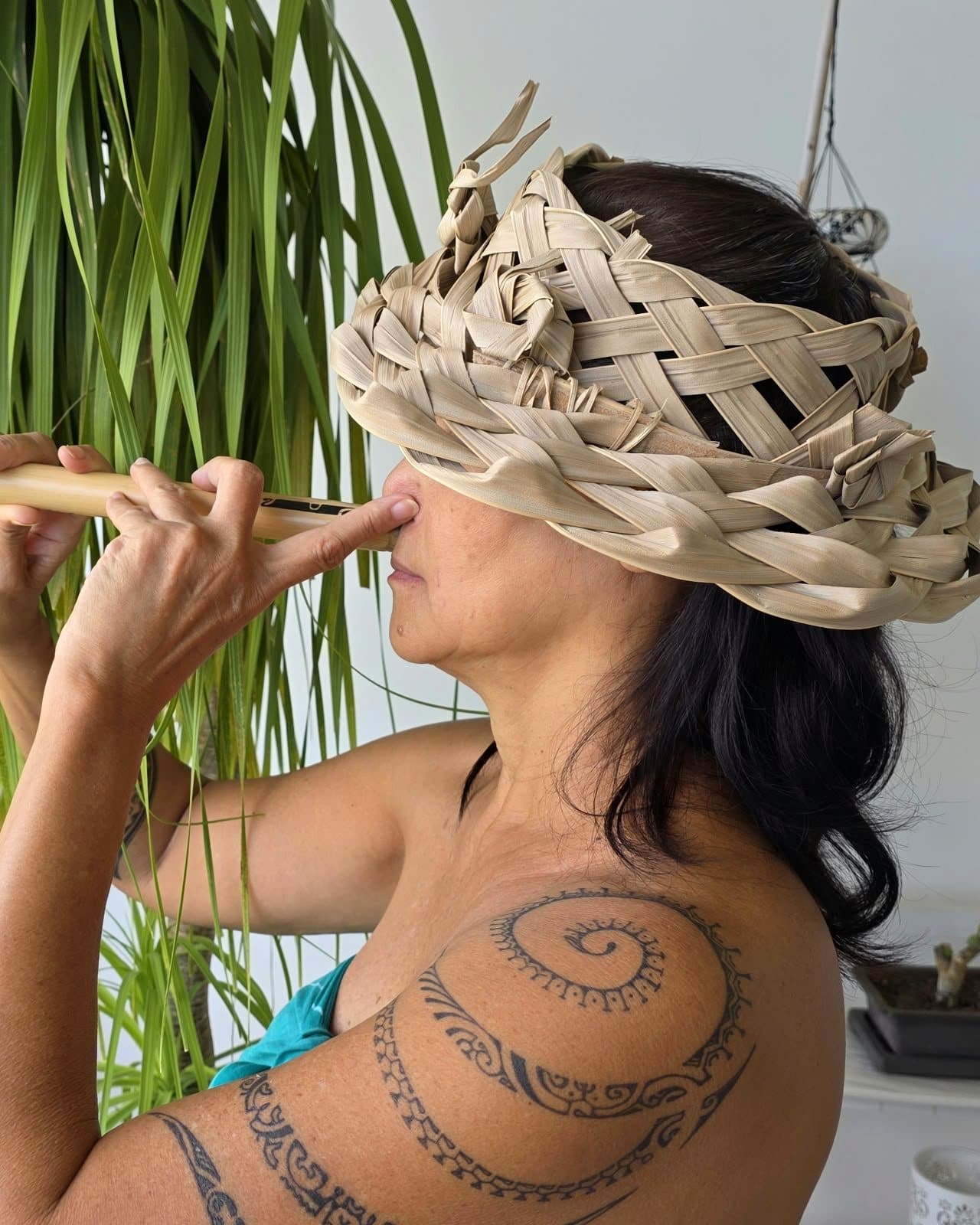
The first Europeans to reach Tahiti noted it with astonishment. Then, for decades, the vivo fell silent. The story of an unassuming flute, and of its return.
“Blowing with his nose”
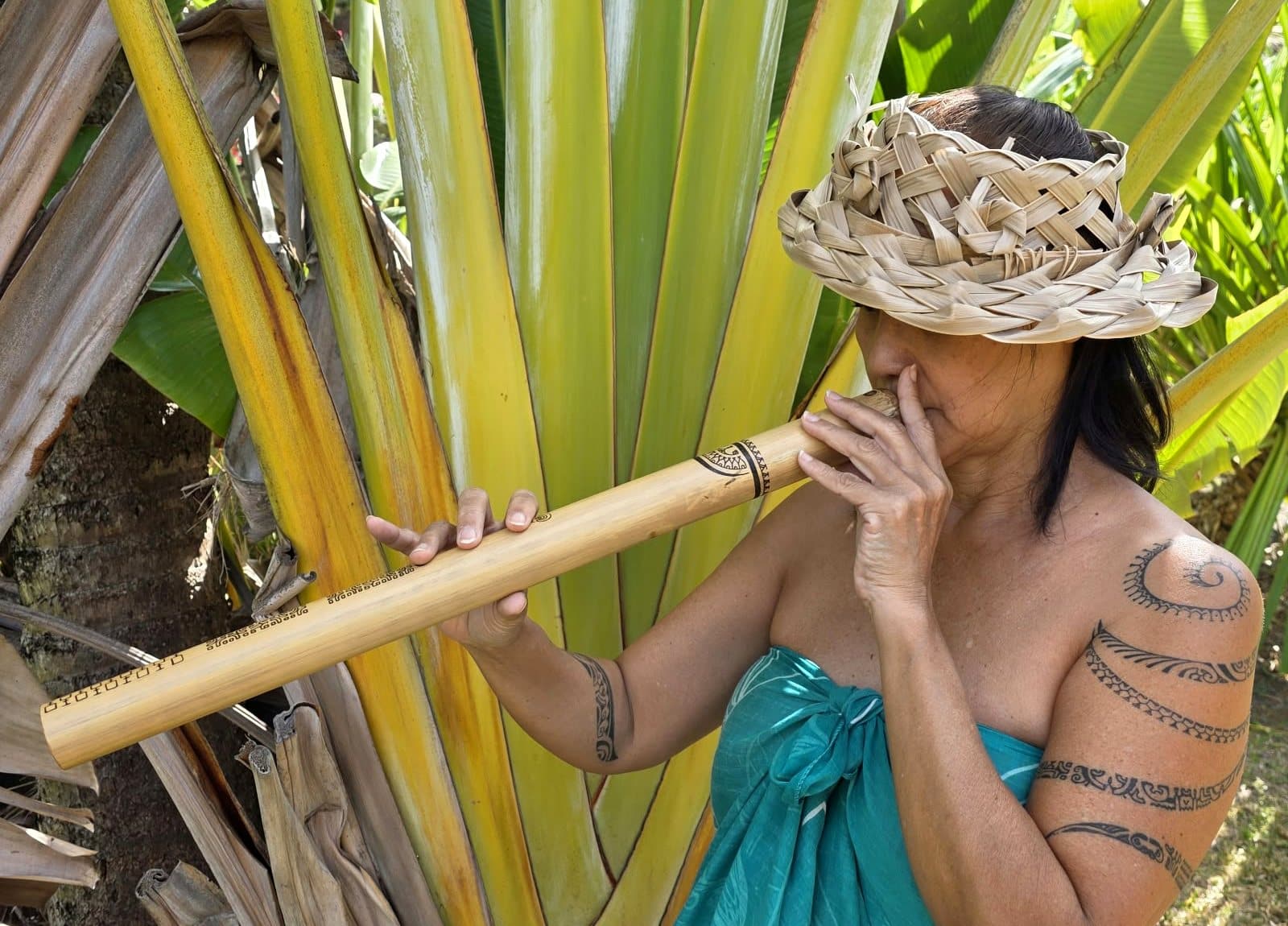
April 1768. Bougainville had just dropped anchor off Tahiti. A man began to sing for the newcomers, slowly, to the sound of a flute into which another man “was blowing with his nose” (soufflait avec le nez, in Bougainville’s French)1. It is, as far as we know, the first time a European described the vivo.
A year later, on April 22, 1769, it was the turn of Joseph Banks, the naturalist on Cook’s expedition. Four musicians played their flutes with one nostril, stopping the other with a thumb; four more sang along, keeping good time2. This is how he described the instrument:
The former is made of a hollow bamboo about a foot long in which is 3 holes; into one of these they blow with one nostril stopping the other with the thumb of the left hand, the other two they stop and unstop with the fore finger of the left and middle finger of the right hand; by this means they produce 4 notes and no more.
Joseph Banks, 17693
Four notes, he went on, “of which they have made one tune that serves them for all occasions”3.
One bamboo, three holes
The vivo is cut from a single section of bamboo, called ‘ofe in Tahitian4. One end is left closed by the natural node; the other is cut clean. Close to the node is a hole for the breath; farther along, two holes for the fingers. Those are Banks’s three holes: one to blow into, two to play.
To see a vivo from that period, you have to go to Germany. The University of Göttingen holds one brought back from Cook’s voyages: forty-three and a half centimeters of yellow bamboo4. Its holes were not drilled; they were burned in with a hot iron. Two more, one of them shorter, are kept in Hanover5, and still others in Sydney, Vienna, Oxford, and Cambridge4.
The Göttingen flute is bare. As a rule, Tahitian flutes were not: they were wrapped in braided cord made of coconut fiber and, sometimes, of human hair4.
Bamboo is not the only material. Vivo have also been carved from wood and from bone, human or animal6.
Then there is the way it is held. According to a study published in Vienna in 1955, the vivo sounds best at an angle of about thirty degrees to the nasal septum4.
For celebrations and for every day
The old catalog entry that accompanies the Göttingen flute speaks of “a plaintive sort of music” of a few notes4. Plaintive, that is, to an eighteenth-century English ear. Yet the journals of Cook and Forster mention the vivo in everyday life as well as on great occasions: welcoming ceremonies, heiva, and the public appearances of the ‘arioi, a society at once religious and artistic, in which flutes and drums were played together. It was also heard accompanying the telling of myths4.
The vivo has cousins. In Hawai‘i, the ‘ohe hano ihu was played for one listener alone7; Tonga has its fangufangu8; Aotearoa, its kōauau ponga ihu, made from a small gourd9. Each island group has its own name for the instrument, its own way of making it, its own uses: cousins, not twins.
Silence, then the return
Then the vivo fell silent. The Musée de Tahiti et des Îles speaks of decades in which it was forgotten, until dance groups took it up again in the late 1980s10. In 1993, at the Heiva, the musician Libor Prokop, appearing with the troupe Heikura Nui, presented a six-hole vivo he had made himself, tuned to the keys of today’s songs11. Craftspeople are carving bamboo once again; each piece, they say, sounds different depending on the bamboo chosen11.
On October 3, 2026, the vivo was featured on the television news: Teaniva Dinard played his own, having won a first prize the week before. He thanked those to whom the instrument owes its return, among them Libor Prokop and Coco Hotahota, the founder of the troupe Te Maeva12.
There are more holes now. The gesture has not changed.
The breath of life
Why the nose? Those who make and play the vivo today put it this way: the breath of the nose is pure, whereas the breath of the mouth can be sullied by speech. It is also the breath of life: the first at birth, and the last11. For the ancients, it is said, the vivo has a soul, and a language made of sounds and tattoos that links it to the divine.
Patricia’s vivo
Patricia has three vivo, each engraved “KokoPatu.”
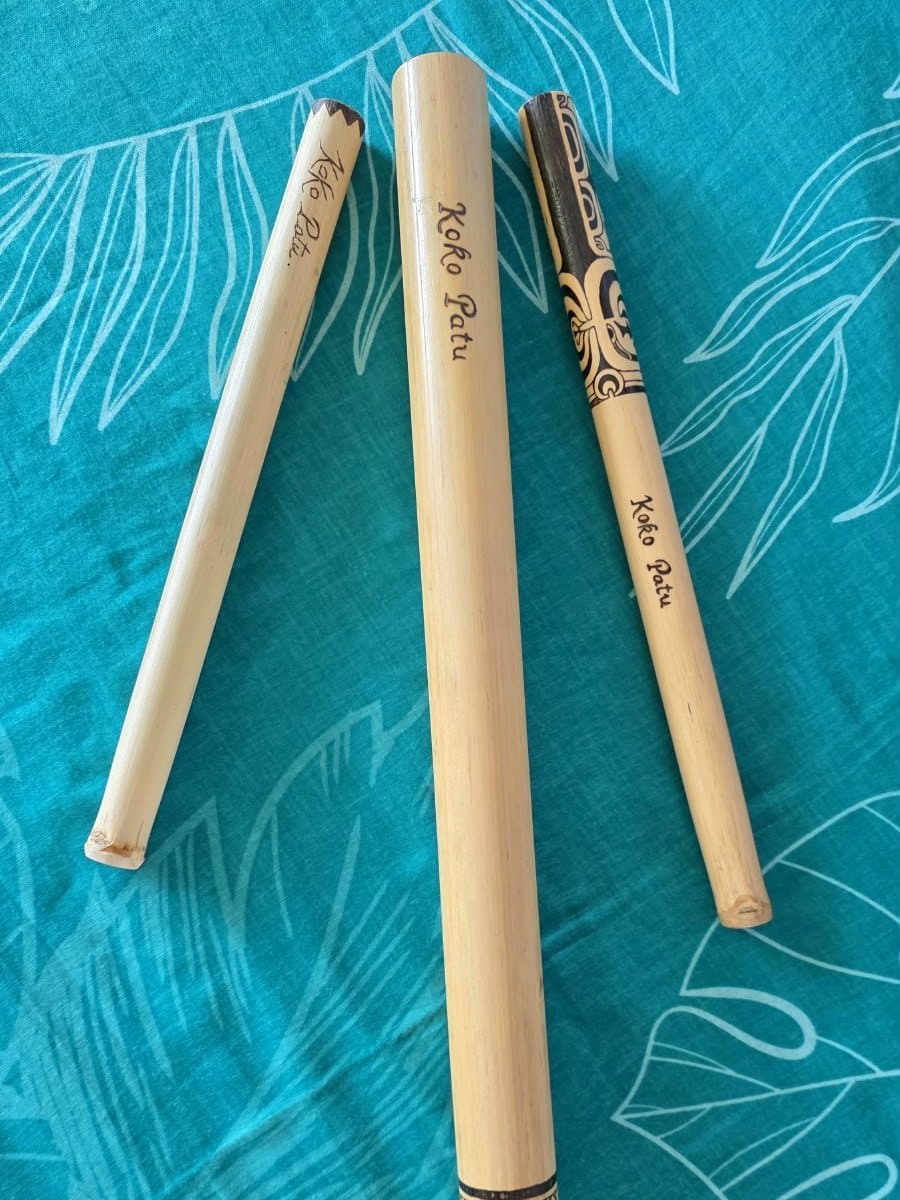
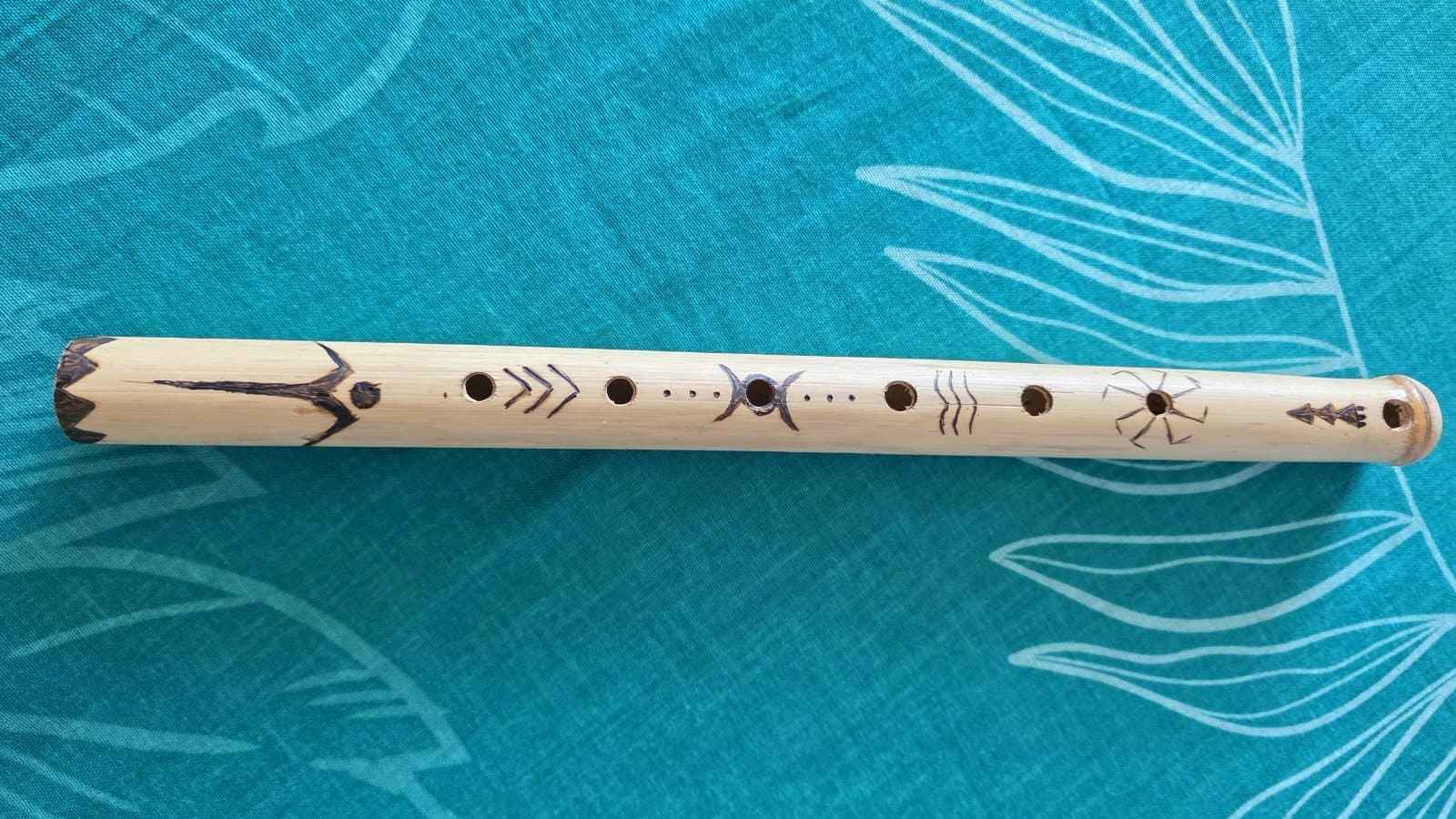
The smallest, thirty-five centimeters long with six holes, she made herself at the Centre ‘Arioi, in a workshop led by Keanu Hikutini, from sawing the bamboo to engraving the symbols. She took those from the booklet handed out that day, and added one of her own: three moons.
The other two come from Samuel Poepoeani, who personalized them for her. The large one measures fifty-five centimeters and has only three holes: the longer the flute, the lower the note.
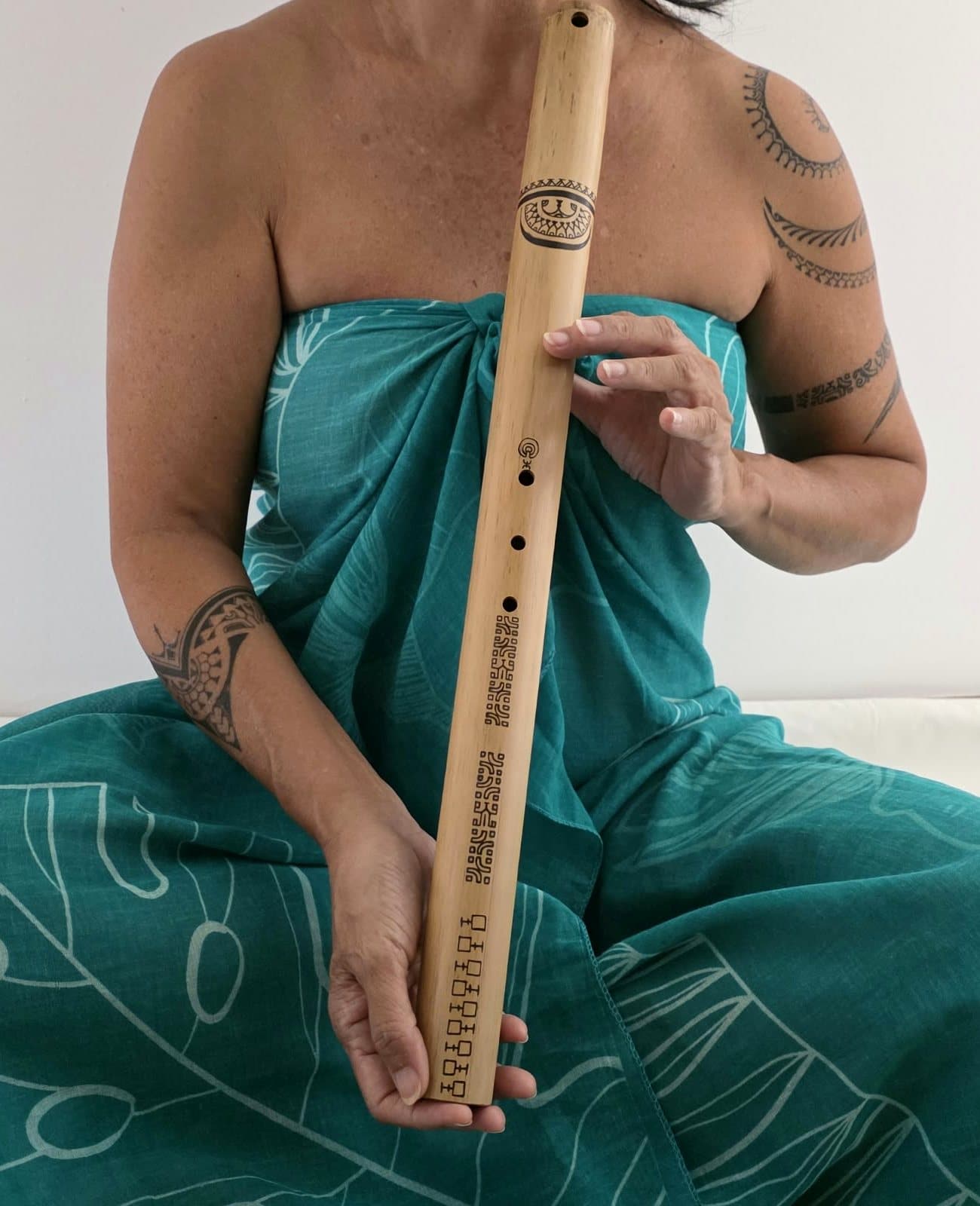
One clarification: the vivo is not yet heard in her relaxation sessions. She is getting to know it, at her own pace, before bringing it in.
This is a breath that does not push; it barely touches.
Next new moon: Tuesday, December 8. Another instrument will step out of the collection.
With each new moon, an instrument from the collection tells its story, whether or not it is played in a session.
A session is something else: some fifty minutes to let body and mind unwind, carried by the instruments of the four worlds of sound.
Notes and sources
- Louis-Antoine de Bougainville — Voyage autour du monde, ch. IX (1771), Wikisource (in French)↩
- Joseph Banks — The Endeavour Journal, April 22, 1769, Wikisource↩
- Joseph Banks — “Manners and customs of South Sea Islands” (1769), Wikisource↩
- Gundolf Krüger — “Nose flute vivo,” Oz 408, Cook-Forster Collection, University of Göttingen (after Humphrey, Parkinson 1773, Henry 1928, Moschner 1955, Wolf 1941, Kaeppler 1978), National Museum of Australia↩
- Gundolf Krüger — “Nose flutes vivo,” Hanover 1854 no. 13, Forster Collection, National Museum of Australia↩
- Éducation en Polynésie française (ebooks.education.pf) — “Instruments de musique traditionnels,” entry on the vivo (in French)↩
- Ke Ola Magazine — “Hawaiian nose flute” (‘ohe hano ihu)↩
- Te Papa — “Fangufangu (nose flute),” Tonga↩
- Te Ara, Encyclopedia of New Zealand — “Kōauau ponga ihu”↩
- Musée de Tahiti et des Îles — “Le vivo ou flûte nasale” (in French)↩
- Polynésie la 1ère — “Grâce au vivo, le souffle sacré des anciens est encore plus vivace” (May 13, 2026; in French)↩
- Polynésie la 1ère — Le Journal, Saturday, October 3, 2026, segment “Te Hono Rahu’a, le vivo à l’honneur” (in French)↩